
Zulfiqar Ahmad
Fatehul Mulk Ali Nasir has gone to jail. For a scion of Chitral’s old ruling family, that sounds like a strange launchpad for a political career.
But this is Pakistan, where jail has never been the career-killer it would be almost anywhere else. Here, a cell can be a career move.
The Mehtar, grandson of Shuja-ul-Mulk, carries a political lineage older than the country he now serves. The Katoors ruled Chitral until the princely states were swept away in 1969.
The throne vanished. The family did not. Names survive. Memories survive. Networks survive. And politics – ever the opportunist – makes room for all three.
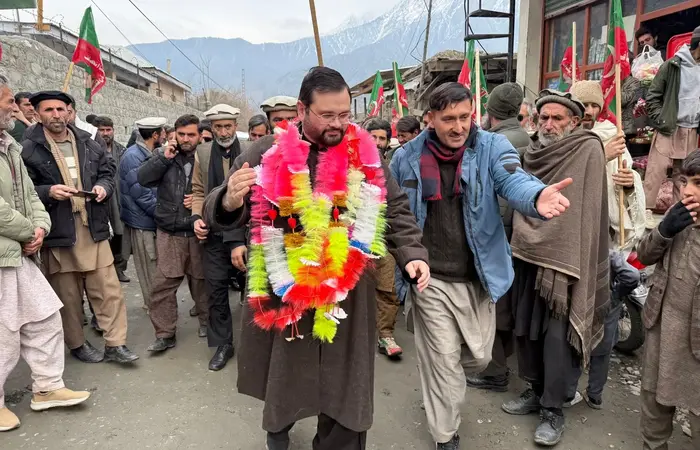
Fatehul Mulk stepped into electoral politics with that inheritance strapped to his back. When he won in 2024 elections, he did not swagger – he bowed.
His remarks dripped with deference to elders and gratitude to Imran Khan – no chest-thumping, no declarations of arrival, unlike his colleague Suriya Bibi. He looked less like a new political force and more like a well-mannered heir minding his family’s reputation.
Then came the jail. He could have vanished – Chitral’s valleys have swallowed plenty of men in trouble over the centuries. Instead, he walked in. He presented himself for arrest over his ties to PTI and Imran Khan, no theatrics, no disappearing act.
Does that prove anything? Not really – not yet. Pakistani politics has a peculiar habit of minting martyrs by the day: the longer the lock-up, the shinier the political halo. Given our history, the instinct makes sense. But it is also a little too convenient. A jail cell can forge a legend. It can also just be four walls and a cot.
Still, for Fatehul Mulk, this may leave a mark. Until now, his political identity has been inseparable from his surname – understandable in Chitral, where the Katoors hold something no rupee can buy: instant recognition. But recognition gets you through the door. It does not win you the room.
The real test comes next. Can he build a following that answers to him, not his family tree? Can he win over voters who could not care less who the Mehtars were? Can he build alliances beyond the family’s address book?
And can he turn “PTI loyalist” into something sturdier than “Katoor heir with a cause”?
None of that gets settled behind bars. It gets settled in the open, where votes are counted and dynasties do not count for much.
There is a delicious irony buried in all this. The Katoors once ruled by birthright, no elections required. Fatehul Mulk now plays a game where authority has an expiry date and must be renewed, term after term, at the ballot box.
The family name can get him a seat at the table. It will not order his meal for him.
This is the loop Pakistani politics cannot seem to escape: princes turn into politicians, politicians turn into prisoners, prisoners turn into symbols, and symbols – if they are lucky or ruthless enough – turn into politicians all over again. Whether Fatehul Mulk breaks out of symbol status and into something real is still an open question.
For now, though, the Mehtar Fatehul Mulk Ali Nasir has picked up something no ancestor could ever have willed to him: a political education, earned the hard way, entirely his own.
Related:
Mehtar of Chitral Fatehul Mulk joins PTI