
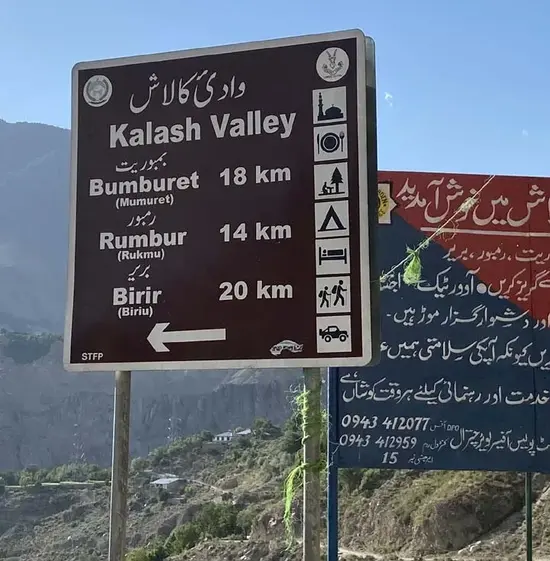
CHITRAL: A citizen proposal has called for a comprehensive Kalash Heritage Blueprint aimed at strengthening community custodianship, protecting cultural and ecological heritage and creating sustainable livelihood opportunities for Kalash communities.
The proposal, submitted by Maj (r) Zuhaib Farooq in his personal capacity, seeks consultation among Lower Chitral MPA Mehtar Fatehil Mulk Ali Nasir, Kalash community leaders, government institutions, development organisations and heritage bodies.
The blueprint proposes giving Kalash communities a greater role in decisions concerning their heritage, with a proposed convening role for the Mehtar and coordinated participation by district, provincial and federal institutions.
It also calls for linking conservation, cultural learning, responsible tourism and youth skills with local employment and enterprise opportunities.
According to the proposal, heritage and ecological protection would be supported through community-governed documentation, environmental monitoring and carefully selected artificial intelligence tools.
The blueprint further proposes a costed implementation programme with measurable milestones, accountable delivery and pursuit of a UNESCO pathway through Pakistan’s competent authorities.
Another component of the proposal is a wider “peace-dividend” framework examining how stronger local institutions, dignity and economic opportunities could contribute to stability and regional cooperation involving Pakistan and neighbouring countries, including Afghanistan, India and Iran.
The proposal says the wider regional economic value could potentially reach billions of dollars if gains in peace, trade, livelihoods and avoided disruption materialise. It stresses that such projections should be subject to rigorous assessment and distinguished from programme-level returns.
The immediate objective, according to the proposal, is to turn the vision into a community-reviewed and institutionally supported programme of practical work. It calls for timely consultations to establish priorities, identify potential partners and align activities with the seasonal calendar of the Kalash valleys.
The author has invited community leaders and the Mehtar to consider the proposed custodianship and consultation framework, while government and institutional bodies have been asked to identify a focal person for technical review and an initial discussion.
Development, heritage and philanthropic organisations have also been invited to consider participation within their respective mandates, while editors and journalists have been urged to examine the proposal and bring Kalash voices and institutional perspectives into public discussion.
The proposal describes itself as an independent citizen initiative, with community participation, institutional adoption and partnerships to be determined through appropriate consultation and agreement processes.
Related:
The Kalash do not need another glossy development proposal dressed up as salvation. They need something Pakistan has rarely offered them: honesty about what their survival actually demands, and the will to provide it.
Maj (retd) Zuhaib Farooq’s “Kalash Heritage Blueprint” ticks every box the development lexicon offers: tourism, employment, environmental monitoring, cultural education, youth skills, a UNESCO pathway, even a regional “peace dividend.”
It reads, on paper, as comprehensive. What it conspicuously does not ask is the one question that matters: what, precisely, is being preserved, and for whom?
The Kalash are not a tourist backdrop. They are not festivals staged for cameras, or villages curated for visitors.
They are a small indigenous community with their own religion, language and social order, and if that community keeps shrinking and converting, then “heritage preservation” amounts to preserving scenery after the people have gone.
This is not a new anxiety. Advocates have flagged demographic decline, assimilation and conversion for years, including the uncomfortable pattern of young Kalash converting to Islam, and of Kalash girls being encouraged towards marriage to Muslim men after conversion.
Any serious strategy has to name this pressure plainly. A blueprint that dances around it is not cautious. It is evasive.
That evasion is the real danger. The vocabulary of development, skills, sustainability, infrastructure, heritage trails, is seductive precisely because it is comfortable.
It lets policymakers sound engaged without confronting the harder truth. A hotel does not preserve a language. A tourism campaign does not halt assimilation. A UNESCO plaque does not reverse a demographic slide.
These may be necessary components, but they are not the whole answer, and treating them as such risks a strange outcome: everything around the Kalash preserved and packaged, while the Kalash themselves keep shrinking.
A credible strategy would ask harder questions. Why are Kalash youth leaving their ancestral faith? Are children actually free to learn and practise their religion, or do they grow up under social and economic pressure that makes conversion the path of least resistance?
What legal protections exist, and where do they fail? And what voluntary measures, respectful of rights, would let the community sustain its identity on its own terms, not on terms drafted for it elsewhere.
The numbers deserve scrutiny too. The claim that the region’s economic potential “could potentially reach billions of dollars” is, by the proposal’s own admission, speculative and in need of rigorous assessment.
That caveat is fair, but not enough to bury an eye catching figure in a footnote while it does rhetorical work courting investors and partners.
To be clear: no one should dictate whom the Kalash marry or what they believe. That is not, and should not be, the goal.
The goal is that being Kalash remains a viable, dignified, freely chosen way of life for the next generation, not a diminishing statistic dressed in ceremonial colour, quietly vanishing from the valleys it once defined.