
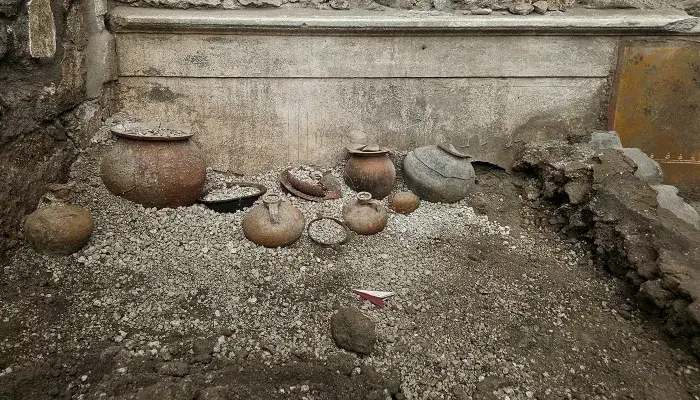
ROME: Archaeologists have uncovered a collection of remarkably preserved personal belongings, including a glass perfume bottle, makeup tools, coins and a child’s necklace, in the ancient Roman city of Pompeii, which was buried following a volcanic eruption nearly 2,000 years ago.
Pompeii, located in Italy’s Campania region, was destroyed in 79 AD when Mount Vesuvius erupted, burying the city beneath four to six metres of volcanic ash.
The latest discoveries include personal belongings of the city’s former residents, which were recovered from a wooden cabinet that remarkably survived the disaster. The cabinet was found inside a room of a residential property along Via dell’Abbondanza, one of Pompeii’s densely populated streets.
Among the recovered objects are tweezers, a glass perfume bottle, an incense burner and a bronze lantern. The discoveries offer valuable insights into the everyday lives of Pompeii’s residents before the catastrophic eruption.
However, one of the most remarkable finds is a child’s necklace made from several different materials. According to archaeologists, children in ancient Roman society wore such necklaces as protective charms or as a means of identification.
Experts say these ornaments held considerable significance in Roman society and could also indicate that a child’s parents were not living with them, a situation believed to have been relatively common at the time.
The cabinet also contained 38 bronze coins, cooking pots and a wooden box. These objects suggest that the property’s owner may have been a merchant or craftsman.
Archaeologists believe the presence of valuable possessions and personal belongings left behind indicates that residents fled their homes in panic following the volcanic eruption.
The house was originally excavated from volcanic ash in 1912. However, archaeologists have only recently restored its rooms as part of a dedicated project, enabling further examination of the site and its contents.
Excavation work is still underway in the surrounding areas of Pompeii. Experts believe that large sections of the ancient city remain buried beneath volcanic ash and have yet to be fully uncovered.
Further archaeological work is expected to shed more light on the lives, possessions and social customs of the people who lived in Pompeii before its destruction.
Related:
New Study Revives Theory of Human Sacrifice in Ancient Egypt