
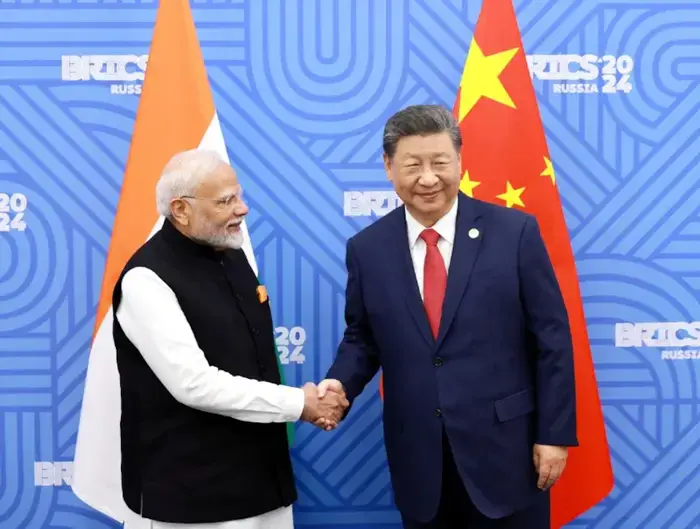
NEW DELHI (Reuters): Chinese President Xi Jinping’s expected visit to India this week could help advance a diplomatic thaw between the two Asian powers, but significant barriers continue to weigh on their economic and business relations.
Xi’s first visit to India in seven years is expected to coincide with the annual BRICS summit in New Delhi. Beijing has yet to officially confirm the visit, while it also remains unclear whether Xi will hold talks with Indian Prime Minister Narendra Modi.
A meeting between the two leaders could prove important in determining the future direction of bilateral relations. The two countries have sought to improve ties in recent years after relations deteriorated following a deadly border clash in 2020.
China and India fought a brief war in 1962 and have maintained a wary relationship for decades. Tensions intensified after the 2020 border confrontation, which killed 20 Indian and four Chinese soldiers.
Relations have improved since then, particularly following Modi’s visit to China last year, as both countries also navigate increasingly complicated relations with the United States.
Analysts, however, say a major breakthrough in economic relations is unlikely in the near term because businesses continue to face regulatory hurdles, visa delays and restrictions on industrial equipment.
“China certainly wants to improve ties, but we are waiting to see to what extent India is actually willing to improve them,” said Lin Minwang, a South Asia expert at Fudan University and former diplomat at China’s embassy in New Delhi.
Harsh Pant of New Delhi’s Observer Research Foundation said the trust deficit between the two countries remained high, although China’s economic strength could provide an opportunity for both sides to develop a more reliable partnership.
India eased some restrictions on Chinese investment in March, particularly in electronics, capital goods and solar cells, and has been considering faster approvals for certain joint ventures.
New Delhi has since approved projects including a manufacturing venture between Indian electronics maker Dixon Technologies and Chinese smartphone company Vivo.
However, major Chinese automakers such as BYD and Great Wall Motor have not resumed planned investments in India after facing increased scrutiny from New Delhi.
Chinese companies are also facing greater scrutiny from Beijing, particularly in sectors involving advanced manufacturing and high-end technology, according to sources familiar with the matter.
China’s Foreign Ministry said Xi and Modi viewed their countries as “partners, not competitors” and believed they represented opportunities rather than threats to each other’s development.
Meanwhile, India has declined to approve a proposal by Alipay, linked to China’s Ant Group, to connect with India’s instant payments system, citing national security concerns.
India is also considering a recommendation to investigate Chinese smartphone maker Xiaomi over alleged business irregularities and possible violations of foreign investment rules. Xiaomi has said it complies with local laws.
Chinese authorities have also reportedly asked companies not to sell critical technology and infrastructure equipment to India, including port equipment, solar panels and mobile manufacturing machinery.
Although India and China resumed direct flights last year and New Delhi eased visa procedures for Chinese business visitors, some Indian businesspeople have recently faced difficulties obtaining Chinese visas.
Chinese-made equipment and components needed by India’s solar, electronics and infrastructure sectors have also reportedly been held up at Chinese customs. Some large Chinese tunnel-boring machines intended for major Indian infrastructure projects have allegedly been delayed for more than a year.
Analysts say such obstacles point to deeper tensions than routine administrative problems and highlight the strategic importance of economic dependence between the two countries.
A successful meeting between Modi and Xi, however, could help remove some of these barriers. Former Indian trade official Anup Wadhawan said a meeting between the two leaders could provide an opportunity to better align political and economic interests.
Despite the diplomatic thaw, the future of China-India commercial relations is likely to depend on whether both sides can rebuild trust and translate political engagement into fewer restrictions for businesses.