
One minute read time
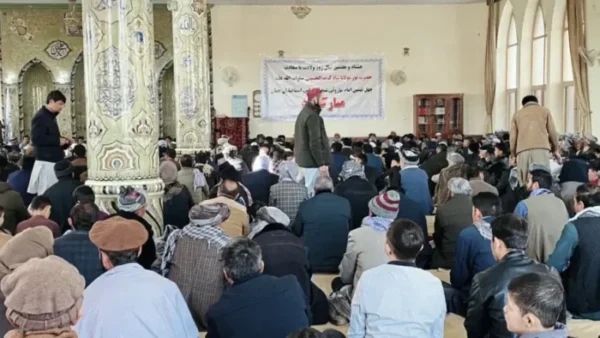
Kabul, July 29, 2026: At least 33 Ismaili prayer halls, known as Jamat Khanas, have been closed in Afghanistan’s northeastern Badakhshan province over the past three months, according to the United Nations, raising concerns over religious freedom and minority rights under Taliban rule.
In its latest quarterly human rights report, the U.N. Assistance Mission in Afghanistan (UNAMA) said the closures occurred between April and June, affecting 17 Jamat Khanas in Zebak, 14 in Ishkashim and two in Wakhan
UNAMA said officials from the Ministry for the Propagation of Virtue and Prevention of Vice, sometimes accompanied by other authorities, ordered the closures and told Ismaili community members to stop using the prayer halls.
The U.N. said authorities cited the presence of mihrabs, or prayer niches indicating the direction of Mecca, arguing that the buildings should function as mosques rather than Ismaili places of worship.
Afghanistan’s Foreign Ministry said the status of the buildings varied following official assessments. It said some had previously been used as mosques, while others served as residences or non-religious facilities, adding that decisions were made individually.
The closures have intensified international scrutiny of the treatment of religious minorities since the Taliban returned to power in August 2021.
The U.N. and rights groups have repeatedly raised concerns over restrictions affecting Ismaili and Shiite Muslims and urged Afghan authorities to uphold freedom of religion and belief.
Read at source
The Taliban’s latest assault on Afghanistan’s Ismaili community has exposed the deep contradiction between their claims of “Islamic governance” and the reality of their rule.
A regime that presents itself as a defender of religion has instead used religious authority as a tool of control – enforcing conformity, suppressing diversity, and punishing those whose beliefs and practices do not fit its narrow interpretation of faith.
The Taliban’s claim to religious legitimacy is not reflected in spiritual authority but in an attempt to impose ideological dominance.
By restricting religious expression, targeting minority communities, and undermining traditions outside its worldview, the regime has turned faith into an instrument of political power.
The closure of Ismaili Jamat Khanas under the disputed claim that mehrabs are reserved exclusively for mosques represents another troubling restriction on Afghanistan’s religious diversity.
A government that claims to uphold Islam cannot credibly invoke faith while denying fellow Muslims the right to practice their traditions according to their own beliefs.
By treating religious difference as defiance and diversity as a threat, the Taliban have revealed a system built less on spiritual conviction than on coercive control.
The Taliban seek to convince the world that they represent Islamic values. Their record, however, presents a different picture: a movement more focused on enforcing obedience than fostering faith, using religious authority as a political instrument while demanding submission from those who do not conform to its vision.
The contradiction is difficult to ignore. The same authorities restricting minority religious expression continue to seek international engagement, humanitarian assistance, investment, and diplomatic recognition.
They benefit from support provided by foreign governments, aid agencies, and international organisations, including groups they have publicly criticised, while those organisations continue vital humanitarian work across Afghanistan.
The Taliban seek the benefits of global cooperation while rejecting the principles that make such cooperation possible: respect for human dignity, religious freedom, and the protection of fundamental rights.
They welcome assistance when it strengthens their authority. Yet when Afghan citizens ask for something far more basic – the right to worship peacefully and preserve their traditions – their demands are ignored. The message is unmistakable: international support is acceptable, but religious diversity is not.
This is the central paradox of Taliban rule: they seek recognition from the outside world while denying recognition to many of the people they govern.
They demand acceptance of their authority while refusing to acknowledge the rights and dignity of Afghanistan’s diverse communities.
The Ismaili community has faced insecurity and discrimination for years, and these latest restrictions deepen concerns that religious minorities remain vulnerable under Taliban rule.
A government claiming religious authority cannot selectively invoke faith while denying others the freedom to follow their own traditions.
The international community must not normalise such repression. Engagement with Kabul cannot become a blank cheque for violations of religious freedom and minority rights.
Those with influence over the Taliban, including Qatar, China, the UAE, the United Nations, and other regional actors, must move beyond quiet diplomacy and use their leverage to press for meaningful protections for vulnerable communities.
Silence is not neutrality. It risks becoming permission. When persecution goes unanswered, it signals to the Taliban and other extremist movements that repression can continue without consequence.
The defence of religious freedom in Afghanistan is not only about protecting one community.
It is about whether the international community will uphold the principle that every person – regardless of sect, belief, or tradition – has the right to live with dignity and worship without fear.
The Taliban regime can best be described as pakhtun ethno nationalist takfiris.