
By Mubasher Bukhari
“One who hasn’t seen Lahore is not yet born” goes a local saying that captures the enduring pull of Pakistan’s cultural capital — a city where centuries of history and shifting empires meet a restless modern energy.
Known as the city of lively hearts, the city of gardens and the heart of Pakistan, Lahore rarely slows down. From the old quarters of the Walled City to its newer middle-class and affluent neighbourhoods, it is also a place where the past is never far from the present.
I have a deep personal connection to Lahore. I was born and raised in the city, where my family’s roots date back 500 years. Over two decades reporting for Reuters, I have watched it expand and change through development projects, political and social movements, festivals and the steady replacement of older traditions with newertrends.
Here are my tips on how to experience the city like a Lahori:
The way around: Lahore offers plenty of ways to move around, but those keen to travel like a local should make use of its extensive network of buses and trains. For a more relaxed circuit, there is also a double-decker sightseeing bus that starts and ends at Gaddafi Stadium, Pakistan’s largest cricket ground, passing by several historical landmarks. Ride-hailing apps such as inDrive, Uber and Careem are also available. More adventurous visitors can flag down a three-wheeled auto-rickshaw, but I would suggest avoiding the motorcycle rickshaws, which can be as uncomfortable as they are chaotic.
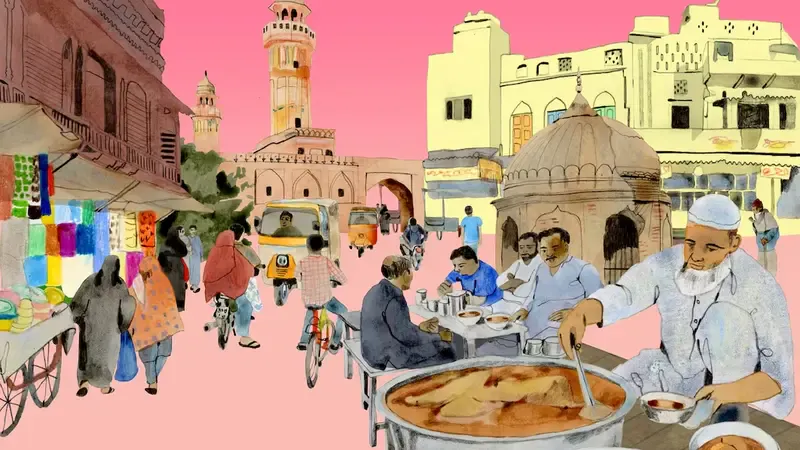
Bites to eat: Lahori cuisine is bold, rich and unapologetically spicy, and breakfast is one of the city’s great rituals. Morning staples include siri-paya, a slow-cooked stew of goat head and trotters; halwa puri, a dish made of fried bread, semolina pudding, chickpea curry and pickle; chikkar cholay, a chickpea curry served with sesame-studded kulcha,a clay oven-baked loaf; harisa, a slow-cooked porridge-like dish made from meat, rice, lentils and wheat; nihari, a slow-cooked meat stew; and a glass of lassi — a blended yogurt drink — to wash it down.
For a proper Lahori breakfast, I would head to the Gawalmandi, Old Anarkali, Temple Road or Lohari Gate neighbourhoods, where most of these dishes can be found for 300 to 1,200 Pakistani rupees (about $1 to $3) per person. My favourites areAmratsari Harisa in Gawalmandi and Phajja Siri Paye in Tibbi City.
By evening, the city turns more carnivorous. Gawalmandi, Old Anarkali, Temple Road, Lakshmi Chowk and Tibbi City are known forkebabs, chicken tikka, tava chicken, Lahore fish and takatak — a dish of chopped offal cooked on a flat griddle to the sharp rhythm of metal spatulas. Standouts include Cooco’s Den opposite the Grand Mosque in Tibbi City and Butt Karahi at Lakshami Chowk. To soften the blow of the spices, try kheer or falooda — an indulgent rice pudding and milk mixed with rose syrup and vermicelli, respectively — for dessert.
For something more upscale, a cluster of restaurants near the Lahore Fort serve traditional dishes with modern touches, often with views of the fort, Badshahi Mosque and Minar-e-Pakistan.
Pro-tip: Carry cash — many of the best places still proudly do business the old-fashioned way.
Historical bonanza: Lahore shows off its centuries of history. The Lahore Fort — a vast complex of palaces, halls and gardens — was once the seat of Mughal power and remains the city’s grandest monument. Plan to spend several hours exploring it.
Opposite stands the Badshahi Mosque, a red-sandstone giant that ranks among the world’s largest. From here, take a rickshaw to Wazir Khan Mosque, famed for its 17th-century Mughal craftsmanship, and the beautiful Samadhi of Ranjit Singh, the resting place of the Sikh ruler of Punjab.
Elsewhere, the Shalamar Gardens showcase impressive water features and bountiful garden pavilions, while the Lahore Museum holds artifacts that trace the region’s layered past. The city’s Britishcolonial inheritance is visible in landmarks such as the Lahore High Court, Punjab University’s Old Campus, the General Post Office, Tollinton Market, and the Punjab Governor’s House.
For those willing to venture further afield, the tombs of the Mughal emperor Jahangir and his wife Noor Jahan in Shahdara, on the other side of the Ravi River, offer another window into the city’s imperial past. At the Wagah border, the daily flag-lowering ceremony between Pakistan and India delivers a theatrical display of nationalism and rivalry.
It’s a city where centuries of history and shifting empires meet a restless modern energy.
For a different side of Lahore, visit its Sufi shrines — includingthose of Data Ganj Bakhsh, Shah Jamal, and Miran Mauj Darya — which speak to the city’s spiritual traditions and history shaped as much by coexistence and devotion as by kings and conquest.
Culture and arts: Lahore is widely seen as Pakistan’s cultural heart, where language, tradition and the arts remain deeply woven into daily life. That is most visible in the Walled City, with its narrow lanes, crowded bazaars and long-held customs.
Pak Tea House is a long-running favourite of Lahore’s literary circles, while institutions such as the National College of Arts have shaped generations of artists, and venues like the Alhamra Arts Council host theatre, music and exhibitions.
Lahore is home to several major classical music gharanas, or schools, and has produced or hosted some of the subcontinent’s most celebrated singing voices, among them Noor Jehan, Mehdi Hassan and Ghulam Ali. Its film and television industry, Lollywood, has also left a lasting mark on popular culture. To take in a show, visit Cue Cinema at Main Boulevard Gulberg, which boasts multiple screens and movies with subtitles.
Where to shop: Lahore caters to every budget. For a traditional shopping experience, Anarkali Bazaar and Ichhra Bazaar remain the best places to browse for clothes, accessories and local goods at modest prices — along with the bustle, bargaining and variety that define shopping in the city.
For something more polished without going fully upscale, Liberty Market in Gulberg strikes a balance between local retailers and brand-name stores, while Fortress Square draws those who prefer indoor shopping and a more comfortable pace.
CITY MEMO DATA POINTS
Population: 13 million
Price of a chai: PKR 80 to 100 (about $0.30) at a roadside dhaba.
Price of a lassi: PKR 150-300 ($0.50 to $1) fromJaida Lassi in the Gawalmandi neighbourhood.
Great place to see a sunset: Lahore Fort on the Badshahi Mosque side around golden hour, then stay into dusk. You’ll get the strongest mix of architecture, atmosphere, and evening lighting. Don’t miss Lawrence Garden (Bagh e Jinnah) for a morning walkorevening jogging.
Largest university: University of Punjab, 51,000 students.–Reuters