
Published July 30, 2026
Three minutes read time
Sardar Nawaz Khan
The ancient Silk Route was more than a network of roads; it was the world’s first great bridge between civilizaations. Stretching from China through Central Asia to Europe, it carried merchants, scholars, and ideas that shaped history.
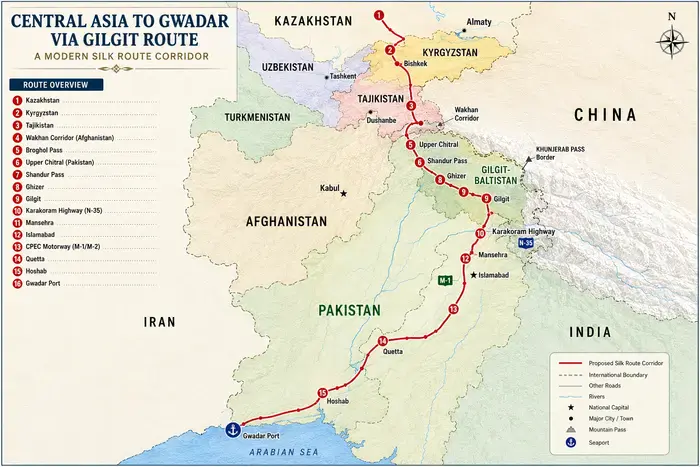
Today, as nations seek new trade routes and stronger regional cooperation, Pakistan has an opportunity to revive that legacy by developing a strategic corridor linking Central Asia to the Arabian Sea through Shandur Pass, Ghizer, and Gwadar Port. But there are two more options: one is from Shah Jinali to Torkhow through Kaghlashst, and the other is from Mastuj to Booni to Chitral.
The five Central Asian republics, Kazakhstan, Kyrgyzstan, Tajikistan, Turkmenistan, and Uzbekistan, possess abundant reserves of oil, gas, minerals, and agricultural products. Yet, being landlocked, they depend heavily on neighbouring countries for access to international markets. Reliable and diversified trade corridors are therefore essential for their long-term economic growth.
Pakistan, especially northern Pakistan, occupies a unique geographical position at the crossroads of South Asia, Central Asia, and the Middle East. Gwadar Port, located on the Arabian Sea, provides one of the shortest maritime gateways to Europe, Africa, and the Gulf region. Strengthening links between Central Asia and Gwadar could create a mutually beneficial trade partnership that serves the economic interests of the entire region.
A modern transport corridor connecting Chitral, Shandur Pass, Ghizer, and Pakistan’s national highway network could become a vital, peaceful and secure component of this vision. Although Shandur and Ghizer are not currently an international trade corridor, investment in all-weather roads, tunnels, bridges, and logistics facilities could transform this historic mountain route into a valuable regional connection.
The economic potential is considerable. Central Asian exports, including energy resources, cotton, dried fruits, minerals, and manufactured goods, could move more efficiently to global markets through the peaceful region to Gwadar. Pakistan would benefit from increased transit trade, foreign investment, employment opportunities, and the development of northern regions. At the same time, businesses in Chitral and Ghizer and the Gilgit-Baltistan region could thrive through tourism, transport, hospitality, and cross-border commerce.
Beyond trade, such connectivity would promote cultural exchange and regional stability. The historic Silk Route united diverse peoples through commerce and dialogue. A modern corridor could encourage educational partnerships, tourism, and stronger diplomatic and economic relations between Central Asia, Pakistan, and European markets.
Realizing this vision will require significant investment, careful environmental planning, and close cooperation among regional governments. The mountainous terrain demands world-class engineering, while customs harmonization, border management, and security cooperation will be essential for efficient trade. These challenges are substantial but not insurmountable.
The revival of the Silk Route should not be viewed merely as a transportation project. It represents a long-term strategy for regional integration, economic diversification, and shared prosperity. By investing in modern infrastructure and fostering partnerships with Central Asian nations, Pakistan can strengthen its role as a gateway connecting Eurasia to the Arabian Sea.
The Shandur–Ghizer to Gwadar corridor remains a vision rather than an established reality. However, with strategic planning, political commitment, and international collaboration, this vision could one day become a landmark achievement in regional connectivity, revive the spirit of the ancient Silk Route and be a part of CPEC for the twenty-first century. A place where peace and security prevail throughout the year.
Related:
Broghil Holds Edge Over Dorah as Safer Route to Central Asia