
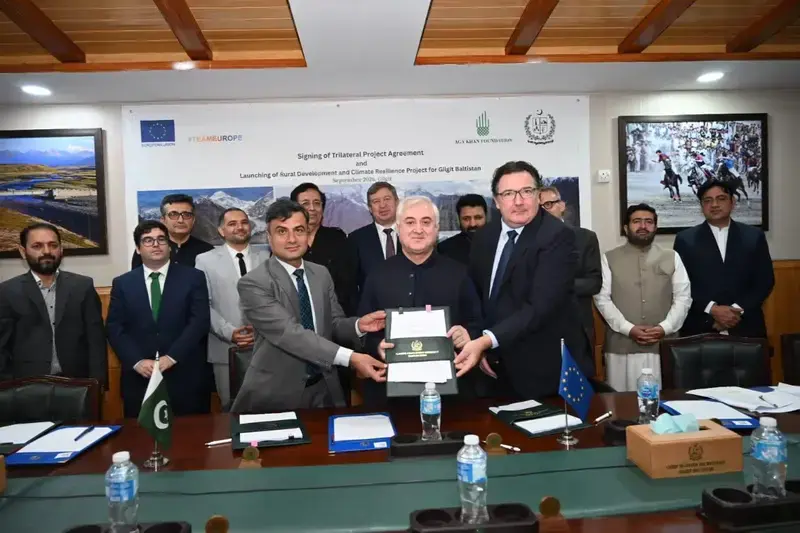
GILGIT: The government of Gilgit-Baltistan, Agence Française de Développement (AFD), the European Union (EU) and the Aga Khan Foundation (AKF) on Tuesday launched the Gilgit-Baltistan Rural Development and Climate Resilience project, aimed at improving living conditions and strengthening communities’ resilience to climate change and natural disasters.
The EUR 54.24 million (PKR 17.2 billion) project is being supported through AFD financing, an EU grant, AKF funding and community contributions, days a press release.
The agreement was formally signed by Gilgit-Baltistan Additional Chief Secretary (Development) Riaz Ahmed, AFD Country Director Marc-Antoine Leclercq and AKF Pakistan CEO Akhtar Iqbal.
The project will introduce climate-resilient interventions across all districts of Gilgit-Baltistan, including 216 water supply and sewerage schemes comprising 117 drinking water projects and 30 sanitation projects, including sewerage networks and wastewater treatment facilities.
The initiative is also expected to generate 1,200 to 1,300 kilowatts of clean energy through hydropower projects. Climate resilience measures will include vulnerability assessments across all 110 Union Councils, green retrofitting of 3,000 households and energy-efficient, resilient construction for another 700 households.
The project will also focus on strengthening local institutions and human resources through training in climate-smart planning, enterprise development and sustainable infrastructure management.
According to the project partners, the initiative is expected to benefit around 43,200 households, or approximately 325,600 people, with women making up at least 40% of the beneficiaries.
During the event, Northern Pakistan Energy Limited (NPak Energy) also presented key findings of the Gilgit-Baltistan Energy Master Plan, a 30-year roadmap developed under the EU-funded Energy Plus project.
The EUR 31 million (PKR 9.8 billion) Energy Plus initiative aims to support the transition towards a climate-resilient, low-carbon economy in Gilgit-Baltistan and Chitral. The Energy Master Plan seeks to establish a reliable, affordable and climate-resilient energy system while addressing Gilgit-Baltistan’s energy deficit and harnessing its renewable energy potential.
The plan was developed in partnership with the Water and Power Department of the Gilgit-Baltistan government, NPak Energy and other stakeholders.
Gilgit-Baltistan Chief Minister Amjad Hussain Azaar welcomed the visiting AFD and EU delegations and Aga Khan Foundation officials, saying the project would contribute to sustainable development and help protect communities from the effects of climate change.
He said the initiative would focus on tangible benefits for local communities, including clean drinking water, improved sanitation, electricity for remote villages, resilient and energy-efficient housing, community-level micro-hydropower projects and employment opportunities for young people.
The chief minister also highlighted ongoing efforts to address the region’s energy challenges through the solarisation of government buildings and development of a regional grid.
EU Ambassador to Pakistan Raimundas Karoblis said the launch marked a significant step in the partners’ efforts to promote a sustainable and resilient future for Gilgit-Baltistan.
He said the EU and its Team Europe partners would work alongside the Gilgit-Baltistan government and Aga Khan Foundation to translate the plans into practical initiatives aimed at climate resilience and inclusive development.
AFD Pakistan Country Director Marc-Antoine Leclercq said the project would improve basic services for the people of Gilgit-Baltistan and help strengthen the government’s institutional capacity to implement a community-driven approach, particularly in remote areas.
AKF Pakistan CEO Akhtar Iqbal said the project reflected the foundation’s long-standing commitment to improving the quality of life of mountain communities through climate-resilient infrastructure, renewable energy, stronger local institutions and inclusive economic opportunities.
The signing ceremony concluded with the participating institutions reaffirming their commitment to working together for inclusive, resilient and sustainable development across Gilgit-Baltistan.
Related:
AKAH working to improve disaster response capabilities
Denmark to fund climate change resilience project in Kalash valley