
ISLAMABAD: The caretaker government on Wednesday approved the establishment of a National Cyber Crime Investigation Agency (NCCIA).
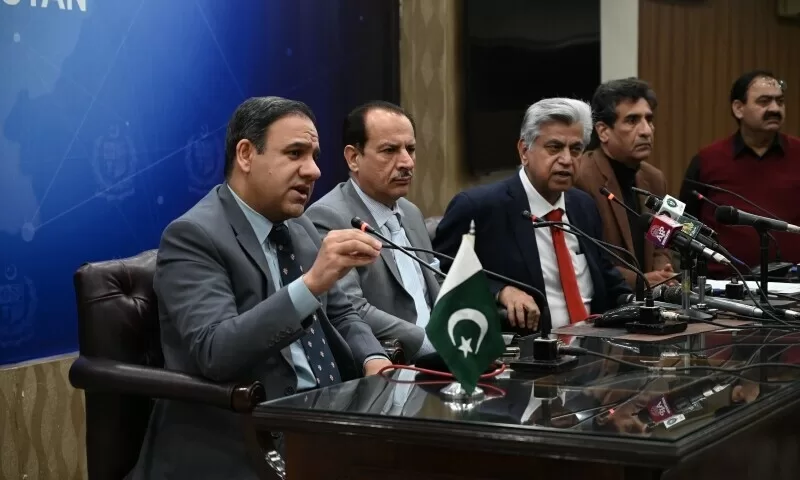
Briefing media after a meeting of the caretaker federal cabinet, minister for information technology (IT) Umar Saif said the agency was needed in the wake of growing cyber crime.
He said the agency would work to ensure safe cyber space for citizens.
The cyber crime cell of the Federal Investigation Agency (FIA) will now be handed over to the new agency.
Under the new agency, telecom tribunals would be set up which would have experts in the field. As a result, cyber crime cases would be decided without taking longer period of time, he added.
SPACE POLICY
Addressing a press conference in Islamabad alongside Saif earlier in the day, interim Information Minister Murtaza Solangi said the caretaker federal cabinet had approved the nation’s first space policy under which international companies would be allowed to provide communication services through low-orbit communication satellites.
He said that under this policy, Pakistan would also establish a space regulatory regime per international standards. He said it would also allow for funds to be allocated to the Space and Upper Atmosphere Research Commission (Suparco) for research and development.
Solangi said caretaker Prime Minister Anwaarul Haq Kakar had appreciated the efforts of the relevant ministries in creating the country’s first space policy. He said that the policy was prepared in consultation with all stakeholders over three months.
Meanwhile, Saif told the media that the space policy was “as important as the telecom policy”.
“Pakistan used to have PTCL landlines and the Telecom Act was introduced to reform this sector, and permission was given for private companies to offer telecom services,” he said.
“That is why you all have phones in your hands and SIMs. Now you do not need the intervention of two MNAs for a landline,” he quipped.
Saif said that satellite communication technology was advancing rapidly and many private companies in the world wanted to provide communication services through low-orbit satellites.
“Satellites used to be geostationary, far away from the land. They are useful for broadcasting TV signals but communicating is difficult because there is latency,” he said.
Saif said that communication services and internet services could be offered through low-orbit satellites, which were relatively closer. He said that there had been a lot of development in this regard in the private sector.