
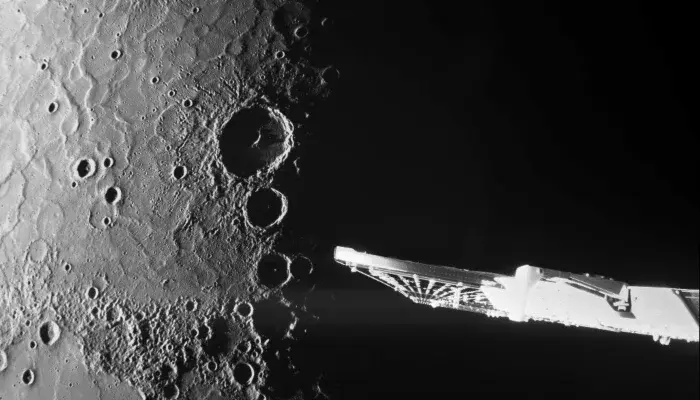
PARIS: The European-Japanese BepiColombo space mission has reached Mercury’s orbit, marking a major milestone in space exploration and only the second successful mission in human history to enter orbit around the solar system’s smallest planet.
After travelling for more than eight years and covering over six billion miles, the spacecraft has finally reached its destination, paving the way for groundbreaking scientific research on Mercury.
BepiColombo is a joint space exploration project by the European Space Agency (ESA) and the Japan Aerospace Exploration Agency (JAXA). The spacecraft was launched in October 2018 to investigate Mercury’s structure, formation, magnetic field and surface conditions.
Before BepiColombo, NASA’s MESSENGER spacecraft was the only mission to successfully orbit Mercury, conducting scientific observations between 2011 and 2015.
The €1.6 billion BepiColombo mission aims to answer important scientific questions about how Mercury formed so close to the Sun, why it has a magnetic field and how frozen water ice exists in permanently shadowed regions near its poles.
Why Reaching Mercury Was So Difficult
Reaching Mercury is one of the biggest challenges in planetary exploration because of the Sun’s powerful gravitational pull, which continuously accelerates approaching spacecraft.
To reduce its speed and achieve the required orbit, BepiColombo performed multiple gravity-assist manoeuvres around Earth, Venus and Mercury during its journey.
Technical problems involving the spacecraft’s propulsion system also extended the mission timeline from the originally planned seven years to more than eight years.
Two Spacecraft to Study Mercury
BepiColombo consists of two scientific orbiters that have remained connected throughout most of their journey. They are expected to separate in December 2026 and enter different orbits around Mercury.
The European spacecraft will create detailed maps of Mercury’s surface and investigate its magnetic field, while the Japanese spacecraft will study the planet’s surrounding environment and magnetic interactions.
Scientists also hope to investigate thousands of craters, unusual surface formations and mysterious geological features to better understand Mercury’s history.
When Will Scientific Research Begin?
Although the spacecraft has reached Mercury’s orbit, its main scientific research programme is expected to begin in April 2027.
The mission has been in development for approximately two decades and is expected to deliver valuable information about the formation and evolution of the innermost planet in our solar system.
Mercury completes one revolution around the Sun in approximately 88 Earth days. Despite being the closest planet to the Sun, it experiences extreme temperature variations.
Daytime temperatures can reach approximately 450 degrees Celsius, while nighttime temperatures can fall to around minus 180 degrees Celsius.
The BepiColombo mission is expected to transform scientists’ understanding of Mercury and provide new insights into the formation and evolution of rocky planets across the solar system.
Related: