
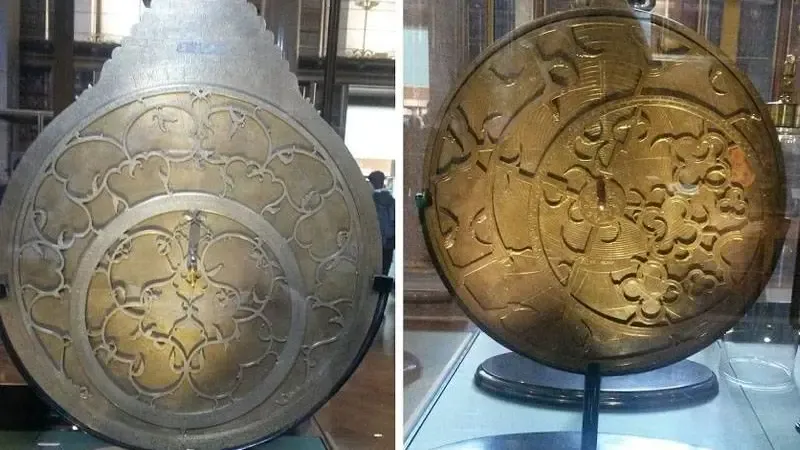
LONDON: A 17th-century brass astrolabe, or what can be described as an early astronomical computer, is set to be auctioned in London.
This extraordinary device, which has been part of the royal collection of Jaipur’s royal family for many years, is displayed at the Sotheby’s London galleries from April 24 to 29, 2026. The astrolabe, valued at an astounding Rs. 94 crore, is expected to draw significant attention from collectors and enthusiasts of historical scientific instruments.
This unique astrolabe, the largest of its kind, was part of the royal inventory of Maharaja Sawai Man Singh II of Jaipur. According to Dr. Federica Gigante, a historian from the Oxford Centre for the History of Science, Medicine, and Technology, these types of instruments were crucial tools in their time, performing tasks that today we might associate with modern smartphones. Dr. Gigante compares them to smartphones, noting their multifunctionality.
The astrolabe could be used for a variety of purposes, such as calculating sunrise and sunset times, determining the height of buildings, measuring the depth of wells, and even calculating distances. It was also instrumental in astrological predictions and the creation of horoscopes.
What makes this particular astrolabe even more intriguing is its origin. It was created in the early 17th century in Lahore, a city that had become a prominent center for the production of such scientific instruments during the Mughal era.
The device was crafted by two brothers, Qayum Muhammad and Muqeeb Muhammad, who were skilled artisans in the Mughal court. They designed this astrolabe for a Mughal noble, Aqa Afzal, who served during the reigns of Emperor Jahangir and Shah Jahan. The brothers only ever created two such astrolabes, making this one of the rarest surviving examples of its kind.
The auction of this historical piece in London represents not just a fascinating glimpse into the advanced scientific knowledge of the Mughal era but also highlights the craftsmanship and innovation of the time. As the astrolabe goes on display and is poised for auction, it is expected to attract the attention of collectors, historians, and scientists alike, eager to preserve and study this invaluable piece of history.