
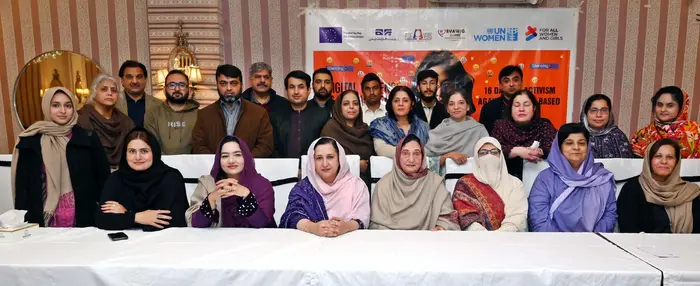
Peshawar, Dec 9, 2025 (APP): A new analysis by Aurat Foundation has revealed that an average of 7.6 women report incidents of violence to police every day in Khyber Pakhtunkhwa, yet the majority of these cases never reach the public eye due to limited media coverage.
The data – compiled under the Rule of Law Project with support from UN Women and the European Union – covers cases recorded between January 1 and November 15, 2025. It documents a wide range of violence faced by women across the province, including murder, honour killings, rape, gang rape, domestic abuse, child marriage, and suicides.
Media silence despite high levels of violence
According to the study, leading newspapers such as Dawn, Express, Aaj and Shumal reported only a small fraction of the cases documented by police. While incidents of murder, honour killings and rape occasionally appeared in print, cases involving domestic violence, suicides and child marriage either received minimal space or were not reported at all.
During the review period, 16 districts of KP recorded no media-reported cases of violence against women, and six districts recorded only one. In 10 categories of violence, there was no coverage in print media.
Of the 186 cases reported in newspapers, murder was the most frequently covered with 104 cases, followed by 19 suicides, 17 honour killings, 7 gang rapes, and 13 rapes. The analysis also found that rural areas accounted for 124 cases, compared to 37 from urban centres—highlighting the heightened vulnerability of women in remote regions.
Digital platforms equally silent
The situation is even starker on social media. Pages with millions of followers across Swat, Mardan, Hazara, Parachinar and other areas showed almost no reporting on violence against women and girls (VAWG), the study found.
Aurat Foundation said this silence allows communities to treat violence as a “private matter”, enabling perpetrators to act without fear of public accountability.
Justice system struggles
Data from the KP Prosecution Office shows that acquittal rates range from 93% to 100% in VAWG cases. Investigations often face delays, evidence is mishandled, and survivors are pressured or intimidated into withdrawing complaints long before cases reach court.
For many women, Aurat Foundation noted, the journey through the justice system becomes more traumatic than the violence itself.
Cultural and social barriers to reporting
The organisation said many women do not report violence due to fear of retaliation, social stigma, lack of legal aid, absence of psychosocial support, and family pressure, which collectively force survivors into silence.
Call for coordinated action
Aurat Foundation urged all stakeholders to break this silence.
It called on:
Media to ensure consistent and ethical reporting,
Police to strengthen survivor-friendly mechanisms,
Judiciary and prosecution to improve evidence handling and reduce delays,
Government institutions to build integrated data systems, and
Community leaders and civil society to challenge harmful social norms.
“When women’s suffering is unreported, it becomes normalized,” the organisation said. “Breaking silence in homes, newsrooms, police stations, and online spaces is essential—not only to document violence, but to end it.”
Related: