
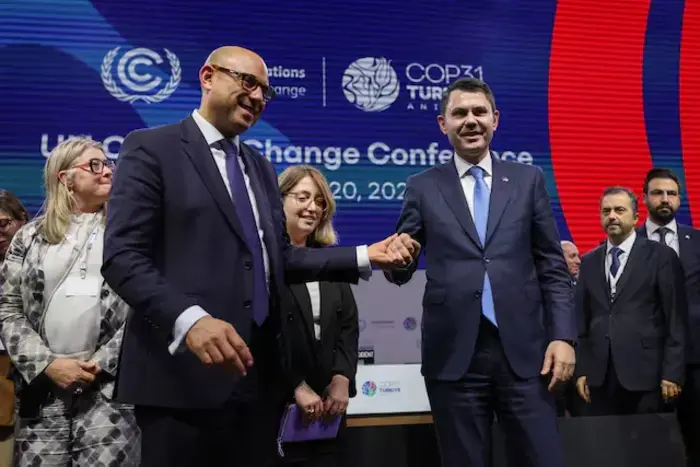
MELBOURNE (Reuters): The shambles at Antalya airport’s taxi stand that greeted the arrival of what felt like all 92,000 registered to attend COP31 was, in retrospect, a foretaste of the dysfunction to come. Two weeks later, the United Nations’ climate summit has ended – a record two days late – without an overarching agreement.
It’s a diplomatic debacle for host Turkey and, as president of negotiations, Australia. But the failure is both healthy and a sideshow.
The COP31 “cover decision” was rejected because petroleum producers, including Saudi Arabia and Russia refused to allow the words “fossil fuel” in the draft. They also insisted on having carbon capture and storage inserted as a climate solution, despite its questionable role. The decades-old technology has the capacity to suck away around 50 million tons of carbon a year at best, just 0.1% of a conservative estimate of global greenhouse gas emissions. This time round, unlike in the past, representatives from up to 130 countries and the European Union refused to accept the greenwashing.
It could be a good step if it leads to a reform of the process; replacing consensus with majority voting would be the ultimate aim. The summit’s impasse also does not undo the deals made in previous COPs: the requirement in the 2015 Paris agreement, reinforced at COP26 in Glasgow six years later, for each country to set national targets to reduce greenhouse gas emissions and to ratchet up their ambition over time, for example, or the agreement to speed up adoption of clean energy at COP28 in Dubai.
It helps, too, that what happens at COP is less important than it used to be. The Paris agreement sent a key signal to companies and investors that decarbonisation was now on the agenda – and arguably it helped to lower renewables’ cost of capital. A decade later economic realities play the dominant role in the energy transition: solar and wind power are cheaper and more efficient than the fossil fuels they are replacing. Even Saudi Arabia’s leaders know that, which is why the country was a top-five importer of Chinese solar panels in 2024. The soaring energy prices from the US-Israel war on Iran not only reinforced those points, they also exposed the threat to countries’ energy security from relying on Middle East hydrocarbons.
Ultimately, COP31 was far from a complete flop. Some 90 countries signed up to the co-hosts’ top priority: a pledge to increase the amount of final energy use coming from electricity from 22% now to 35% by 2035. And 47 countries are on board with the goal of reducing methane and other superpollutant greenhouse gases that are far more potent than carbon.
Turkey’s President Recep Erdogan and Prime Minister Anthony Albanese of Australia have some painful-looking diplomatic wounds to lick. And developing countries will be rightly aggrieved by yet more dismal progress on providing finance for their transition. But COP31’s failure may be far less important than it sounds.
Context News
- The United Nations COP31 climate summit in Antalya, Turkey, ended on November 22 without agreement on the so-called cover decision that the host country and Australia, acting as president of negotiations, had pushed for.
- The EU, Panama, the Marshall Islands and others refused to endorse a cover decision that failed to mention fossil fuels. Some countries also objected to the inclusion in the draft text of carbon capture and storage as an emissions-reduction solution.
- Some progress was made on other key goals at COP31, including as many as 90 countries signing up for the “35 by 35” electrification pledge, and the global platform for methane reduction reaching 47 countries.