
Staff Reporter
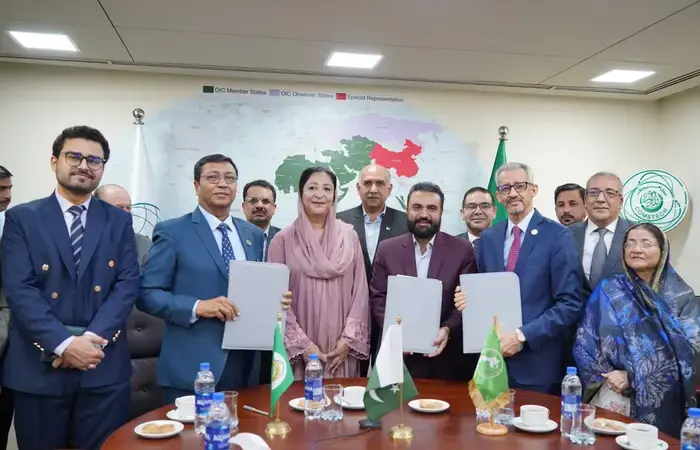
ISLAMABAD: Pakistan and Arabia countries here on Thursday signed a memorandum of understanding (MoU) to strengthen academic, scientific and technological cooperation.
The MoU was inked by the Ministry of Federal Education and Professional Training, the Arab League Educational, Cultural and Scientific Organisation (ALECSO) and the OIC Ministerial Standing Committee on Scientific and Technological Cooperation (COMSTECH).
The agreement was signed at the COMSTECH Secretariat by Higher Education Commission Executive Director Prof Dr Zia Ul Haq, COMSTECH Coordinator General Prof Dr Muhammad Iqbal Choudhary and ALECSO Director General Prof Dr Mohamed Ould Amar. Minister of State for Federal Education and Professional Training Wajiha Qamar attended the ceremony.
Under the agreement, the three organisations will develop joint educational and scientific programmes in science, technology and innovation, and collaborate on conferences, seminars, workshops, exhibitions and professional training courses.
The MoU also provides for establishing ALECSO Chairs at selected Pakistani universities, strengthening links between Pakistani and Arab research institutions, and exploring scholarships and training opportunities for students from both sides.
It further envisages exchanges of experts, academics and researchers, along with sharing knowledge, methodologies and best practices.
Ms Qamar described the agreement as the beginning of a new phase in educational and scientific relations between Pakistan and the Arab world. She said the partnership should create practical opportunities for students, teachers and researchers through scholarships, academic exchanges, training and joint research.
Prof Choudhary said COMSTECH would facilitate cooperation by connecting Pakistani universities and research centres with their counterparts in Arab countries. He stressed that the agreement should lead to measurable initiatives benefiting students and academic institutions.
Prof Amar said the MoU provided a practical framework for closer cooperation in education, culture, science and technology. Prof Zia Ul Haq said stronger institutional links could create new opportunities for universities, scientists and young researchers.
The parties agreed to identify priority projects and establish coordination mechanisms to implement and review activities under the agreement.