
CHITRAL, Dec 4, 2025: A major archaeological research initiative in Upper Chitral has entered its third phase, uncovering hundreds of previously undocumented rock art carvings across the Mulkhow Valley.
The project, titled “Digital Documentation of the Ancient Rock Art in Mulkhow Valley, District Upper Chitral,” is being carried out with financial support from the International Institute for Central Asian Studies (IICAS).
The multi-year project is led by Dr. Abdul Hameed, Associate Professor of Archaeology at Hazara University Mansehra, in collaboration with the Directorate General of Archaeology and Museums, Government of Khyber Pakhtunkhwa.
Following an initial identification phase that revealed significant rock art in eight localities — Sha Der, Kahain Lasht, Soragh, Boyan, Chitari, Der Xindoli, Bokht Neini (Kushum), and Pachili (Kosht) — the team has now completed a detailed second phase of documentation.
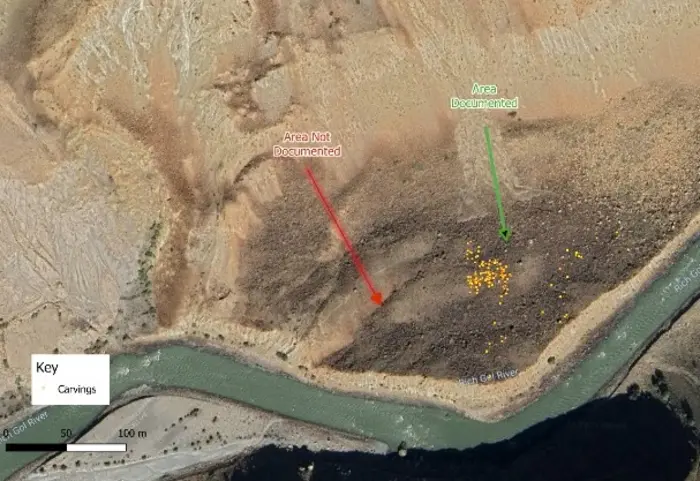
According to the researchers, more than 200 boulders bearing ancient carvings have been identified and meticulously recorded. Using modern techniques such as photogrammetry and QGIS-based mapping, archaeologists photographed each boulder and plotted its exact location to develop precise digital site maps.
The carvings depict a rich variety of scenes, including hunting expeditions, grazing animals and animal combat, as well as individual representations of ibexes, markhors, dogs, yaks, and human figures — some shown standing, others riding horses and aiming bows at wild game.
Additional motifs such as floral patterns, Charma Chakras, and symbolic objects have also been documented.
Preliminary analysis suggests that ancient artists used the pecking technique on many stones, particularly in the Sha Der locality. Researchers noted that the prehistoric carvings appear rougher in execution compared to those from later periods, such as the Late Bronze/Early Iron Age and the Early Historic period.
Dr. Hameed said that the next phase of the project will involve deeper analysis to classify motifs, interpret scenes, and develop a chronological framework based on comparative study.
“These discoveries significantly expand our understanding of the cultural history of Mulkhow Valley and highlight the need to preserve this fragile heritage,” he added.
Local communities have also been encouraged to participate in the project to promote community-based heritage preservation.
The findings mark one of the most extensive digital documentation efforts of rock art ever undertaken in Upper Chitral, shedding new light on the region’s prehistoric and historic past.