
Washington, Nov 18, 2025: Seven years had passed since Jamal Khashoggi, the Washington Post columnist and outspoken critic of the Saudi regime, was brutally murdered inside the Saudi consulate in Istanbul. The world had once been consumed by outrage—by the horrifying details of his killing, the suspicion that Saudi Crown Prince Mohammed bin Salman (MBS) was involved, and the global calls for justice. But as time moved forward, so too did the world’s attention. Khashoggi’s name became a distant echo, a fading memory overshadowed by diplomatic pragmatism and the ever-present pursuit of economic interests.
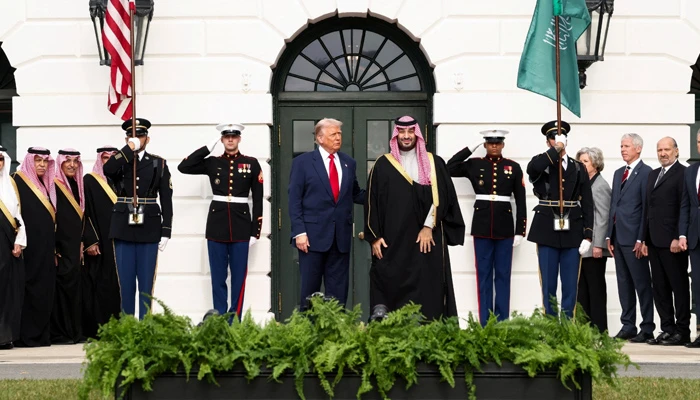
In Washington, the halls of power buzzed once again with a familiar but uneasy tension. President Donald Trump, eager to cement his legacy of strengthening ties with Saudi Arabia, prepared to welcome MBS to the White House. The visit was a celebration of a partnership that was, for many, a necessary reality despite the lingering shadow of Khashoggi’s murder. It was an ostentatious display of pomp—a reminder of the delicate dance between geopolitical strategy and moral compromise.
Trump greeted the Crown Prince with the fanfare of a state visit, complete with a formal black-tie dinner, Oval Office talks, and grandiose promises of multibillion-dollar business deals. The South Lawn of the White House was adorned with both U.S. and Saudi flags, a spectacle that seemed to sweep aside the uncomfortable truths of the past. Behind the smiles and handshakes, the question remained: How could the murder of a journalist, a man who had once sought refuge in the U.S. for speaking truth to power, be so easily forgotten?
MBS’s arrival was more than just a diplomatic gesture. It was a victory for the Crown Prince, a sign that his image—once tarnished by the brutal killing of Khashoggi—was gradually being rehabilitated on the global stage. Seven years had passed, and though the world had initially recoiled in disgust, time had a way of softening outrage. In Washington, the calculus was clear: Saudi Arabia was too important as an oil giant, a defense partner, and a strategic counterweight to Iranian influence in the Middle East. Human rights concerns, it seemed, had been swept under the rug in favor of deals and security pacts.
The visit underscored a broader shift. The intense international outcry following Khashoggi’s murder had once threatened to isolate Saudi Arabia, but the urgency of economic interests had won out. The Trump administration, never shy about pursuing its own financial goals, had made no secret of its desire to deepen ties with the kingdom. With the promise of a $600 billion investment pledge and new defense and technology deals, including the controversial sale of F-35 fighter jets, the visit was set to mark a new chapter in U.S.-Saudi relations—one in which the pursuit of justice for Khashoggi seemed relegated to the past.
The Lingering Question of Justice
For many, however, the visit was a bitter reminder of how quickly the world could forget. In the wake of Khashoggi’s murder, the CIA had concluded that MBS had approved the operation that led to the journalist’s death. Though the Crown Prince denied it, his acknowledgment of responsibility as Saudi Arabia’s de facto ruler did little to quell suspicions. Yet here he was, in Washington, taking his place among world leaders, with the red carpet rolled out before him. No sanctions, no accountability, no meaningful repercussions had followed.
The fates of Khashoggi’s family, his friends, and the many who had hoped for justice felt overshadowed by the political machinery of diplomacy. As MBS and Trump sat across from each other in the Oval Office, discussing defense contracts and nuclear cooperation, the ghost of Khashoggi seemed to hang silently in the air. The promise of justice, once fervently pursued, had all but vanished.
The contrast between the two men could not have been starker. Trump, eager to prioritize the economic benefits of closer ties with Saudi Arabia, was diplomatic in his approach, willing to overlook Khashoggi’s murder as a necessary cost of maintaining the alliance. MBS, for his part, had seemingly weathered the storm, his power unshaken, his international standing slowly recovering through shrewd moves and calculated diplomacy.
Meanwhile, the murdered journalist was slowly becoming a distant memory, buried under the weight of oil deals, arms sales, and high-stakes geopolitics. The promises made in the immediate aftermath of his death—those of accountability and justice—had largely fizzled out in the face of pragmatic alliances. The world had moved on, and those who had once cried out for justice were left wondering: How long could the murder of one man haunt the corridors of power before the voices calling for accountability faded entirely?
A Deal Too Costly for Conscience
The reality of the situation was clear. Khashoggi had paid the ultimate price for speaking truth to power, and in the years since, the world had largely chosen to look the other way. While Khashoggi’s name still appeared in the occasional speech or report, the loud calls for justice had long since quieted. In the corridors of Washington, the diplomatic push for Saudi Arabia to normalize relations with Israel, the talk of defense pacts, and the anticipation of lucrative business deals had all but drowned out the memory of the murdered journalist.
But for those who knew Khashoggi, for those who had worked alongside him, and for those who believed in the power of truth and transparency, the visit of Crown Prince Mohammed bin Salman was a reminder of how far the world had drifted from its initial outrage. His presence in Washington was a testament not only to his survival but to the larger failure of the international community to hold him—or anyone accountable—for the death of a journalist who had become a symbol of the struggle for press freedom and human rights.
As MBS returned to Riyadh, the echo of his visit lingered. In the grand halls of power, where deals were made and alliances forged, the murder of Jamal Khashoggi had become a forgotten tragedy—an inconvenient footnote in a relationship that, for many, had been too valuable to lose.
In the end, it wasn’t just the murder of one man that was forgotten—it was the very promise of justice itself.–Reuters