
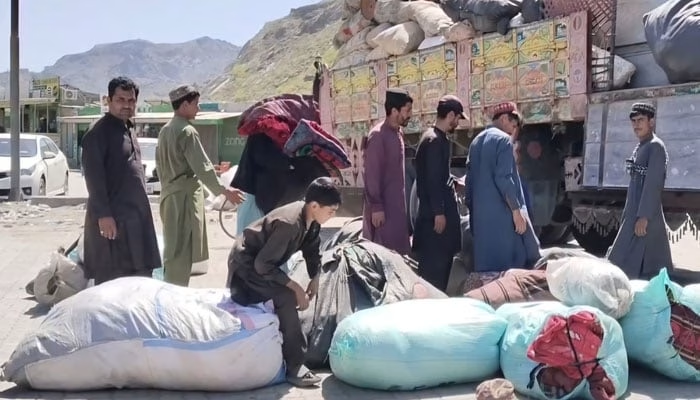
ISLAMABAD, Sept 27, 2025: The federal government has officially denotified 16 Afghan refugee camps across Khyber Pakhtunkhwa (KP), Balochistan and Punjab as part of a broader campaign to repatriate over 1.3 million Afghan refugees holding expired Proof of Registration (PoR) cards.
The move comes after the federal government announced that all PoR cardholders, whose documentation expired on June 30, are now considered to be unlawfully residing in the country. The formal repatriation process began on September 1, following a directive from the Ministry of Interior in July.
According to official notifications issued by the Ministry of States and Frontier Regions (Safron) on September 25, the camps being shut down include sites in Haripur, Chitral and Upper Dir (KP); Chaghai, Loralai, Killa Saifullah, Pishin, and Quetta (Balochistan); and Mianwali (Punjab).
The denotification orders state that all land and non-movable assets within these refugee villages will be handed over to the respective provincial governments and deputy commissioners. Many of these camps were originally established in the 1980s, following the Soviet invasion of Afghanistan, and have since housed tens of thousands of Afghan refugees.
At the Panian camp in Haripur, which reportedly accommodates over 90,000 refugees across 13,000 families, local authorities have informed camp representatives to vacate the area. However, no forced evacuations or raids have been reported so far.
“We’ve been told to leave, but no one has come to arrest or force anyone out yet,” said Haji Abdul Samad, a refugee representative from Panian camp.
KP Chief Minister Ali Amin Khan Gandapur has stated repeatedly that his administration will not forcibly remove Afghan refugees, despite federal directives.
Meanwhile, the United Nations High Commissioner for Refugees (UNHCR) has expressed concern over the denotification of long-established refugee villages, stressing that any return to Afghanistan should be “voluntary, phased, safe and dignified.”
“Many of those affected have lived in these villages for decades and are deeply distressed,” said Qaiser Khan Afridi, UNHCR spokesperson in Pakistan. He emphasized that those with international protection needs should not be subjected to forced return.
Logistical challenges are also hampering the repatriation process. Refugee leaders report that transportation costs for relocating household items to Afghanistan have doubled. Gada Ali Khan Zadran, representing refugees at the Mianwali camp, told Dawn.com that truck fares have surged from Rs300,000 to Rs600,000, leaving many families stranded.
Pakistan began pushing for large-scale repatriation in 2023, citing rising security concerns and strained relations with Afghanistan’s Taliban-led government. Officials argue that with active conflict over in Afghanistan, refugees should now return.
As of June 30, 2025, UNHCR data shows more than 1.3 million Afghan refugees remain in Pakistan. Over half reside in Khyber Pakhtunkhwa (717,945), followed by Balochistan (326,584), Punjab (195,188), Sindh (75,510), and Islamabad (43,154).