
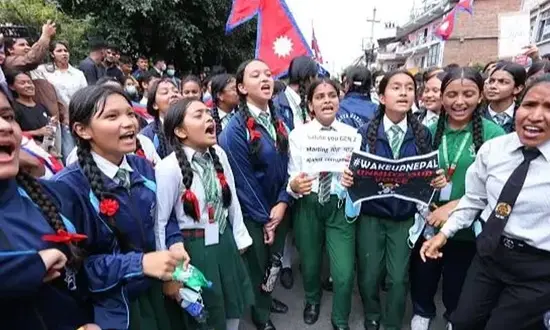
KATHMANDU, Sept 8, 2025: Violent clashes between protesters and security forces in Nepal have left at least 19 people dead, as thousands gathered outside the parliament building in Kathmandu to protest the government’s ban on major social media platforms, including Facebook, X (formerly Twitter), and YouTube.
The demonstrations, organized by a youth-led movement calling itself “Generation Z,” turned deadly when police used force to disperse the crowds. Authorities deployed water cannons, batons, and rubber bullets, triggering chaos and intense confrontations in the heart of the capital.
Nepal’s Minister for Communications, Prithvi Subba, told the BBC that police were compelled to use force after protesters defied restrictions. He defended the government’s move, stating that the ban on social media was necessary to curb fake news, hate speech, and online fraud.
Protesters, many of them young people, carried placards with slogans such as “Enough is enough” and “End Corruption,” accusing the government of increasingly authoritarian behavior. Some demonstrators even scaled the walls surrounding the parliament building, leading to an even more aggressive crackdown by security forces.
According to Kathmandu police spokesperson Shekhar Khanal, 17 people were killed in the capital alone. He told AFP that “tear gas and water cannons were used only after protesters attempted to enter a restricted area.”
In the eastern city of Itahari, a similar protest resulted in two additional fatalities, according to local police sources.
Authorities have now imposed a curfew in and around the parliament complex, as confirmed by a spokesperson from the Kathmandu district office.
Last week, the government issued a blanket ban on 26 social media platforms, citing their failure to comply with national regulations. Officials claimed the platforms had not registered with the Ministry of Communications and Information Technology, as required by law.
The sweeping crackdown has drawn strong criticism from rights groups and members of the international community, who see the move as a serious threat to freedom of expression and democratic values.
As tensions continue to escalate, it remains unclear whether the government will reverse its decision or move to further tighten control over digital communications.