
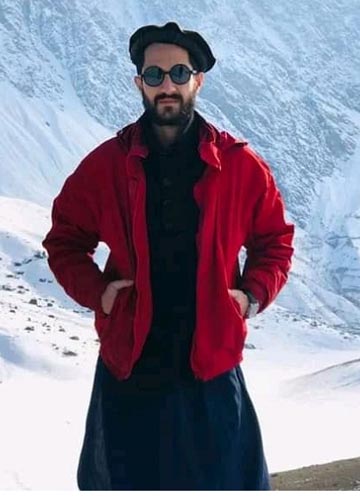
Naeem Khan (Booni)
Recently, a NASA team consisting of people from diverse backgrounds launched the James Webb telescope (world\’s largest ever), costing 10 billion dollars and weighing 6,200 kg into the space. It is being said Webb has the capacity to study, unimaginably, distant galaxies thus allowing researchers to peek into the undiscovered history of the universe. It is an exemplar of what people can achieve when they bring together their potentials.
While one part of the world is pushing the very limits of the human existence, other factions are being pushed into darkness with no hope of salvation. Pakistan in general and Chitral in specific belong to the latter part of the world. The social framework of Chitral is, miserably, plagued with the menace of sectarianism, tribal conflicts and societal segregation in general, hindering its moral and intellectual development.
Albeit, historically, Chitral has been known to possess an inclusive and diverse society, however, factors such as prolonged colonization, group polarization and shortsightedness of leaders have grossly impaired the society\’s ability to function as a one cohesive entity.
Shashi Tharoor, in his book The Era of Darkness eloquently portrays the malicious strategy of the British to \’divide and rule\’. According to Tharoor, the census conducted by the British in the late 18th century was the first one to classify the populace into religions, sects, castes and ethnicities. Furthermore, this data was utilized to allocate specific quotas on the basis of religious, caste or ethnic affiliations in the civil services, governance and the army, embedding a sense of aloofness among the population which, erstwhile, considered itself a single entity.
It can be argued that the allocation of quotas secured the rights of the minorities, however, the intend of the British was to divide the populace rather than the provision of civil rights, making it easier to control the divided opposition to their rule. The colonizers took it upon themselves to define various sections of the society, at the same time, differentiating them from every other.
This practice of \’divide and rule\’ continued for over 200 years, entailing an irreparable rifts between Muslims and Hindus, Shias and Sunnis, allegedly high castes and lower castes and so on. Unfortunately, after the withdrawal of the self-proclaimed sympathetic, British, their policies were embedded in the society to such an extent that it became virtually impossible to eradicate them, instead being used by influential every now and then.
Time and again, it is seen that how religious sentiments and tribal affiliations are sabotaged, to further a person\’s or group\’s agendas. In times of conflict, for instance, during elections, even the most sane amongst the populace succumb to the the seduction of tribal and religious intricacies. Such endeavours, on behalf of elected representatives, might give them an upper hand in the immediate elections, however, serve as a ripple affect in the long term, entailing far-reaching damage to the society. A mere observation of the populace of various regions of Upper Chitral is enough to ascertain the gravity of this issue.
For instance, with due apology to the readers, \’Khow\’ and \’Biyar\’ belt, notwithstanding their close cultural and geographical affinity, are now entirely different entities. Additionally, to prove this assumption, the readers are invited to observe the upcoming elections with an objective and unbiased approach to witness the sheer helplessness of the populace in the face of certain forces.
The third and perhaps the most crucial of the reasons behind societal deterioration is group polarization. Muzaffer Sheriff, a social psychologist, successfully demonstrated the development of inter-group conflicts in an experiment in 1954. He proposed that the conflicts can substantially be reduced and a sense of harmony induced amongst various groups members if they are subjected to cooperation and intermingling. However, in terms of Chitral, this is far from becoming reality due to the emergence of dominant and, at times, rigid tribal and religious groups.
Over the passage of time, these groups have developed extremely polarized ideologies due to reasons such as changing political and regional situations. The rigidity of the polarization is such that individuals, holding rational and dissenting opinions, are unable to voice their true opinions due to the fear of alienation from the group. Additionally, confirming to a certain group\’s ideology brings psychological and social satisfaction, which a particular member undertakes without taking into account the, often, extreme and hateful stance against other groups, in an attempt to legitimize one\’s righteousness and superiority. \’Asch\’s conformity experiment \’ cleverly demonstrates this point. Inter-group conflict in Chitral, is so pronounced that the supposedly intellectual and EDUCATED individuals fail to notice their involvement in its sustenance.
While assimilation is undesirable, diversity isn\’t. Chitral, a conglomerate of various ideologies and tribes, is a blessing in disguise. Endorsing diversity doesn\’t necessarily require the eradication of differences, but accept and honor them as they are, since a colorful painting is more appealing to the eye than one with a single color. The moment we realize the power of unity and the notion of brotherhood, we are to triumph in every domain of our lives. When in the cities, the sound of Khowar, almost intuitively, attracts us towards the source.
Regardless of the source\’s political, religious and tribal affiliation, our eyes glow while seeing Khowar pour out of his mouth, and a sense of Chitrali nationalism effortlessly seeps through us.
Like Matrtin Luther King Jr, I too have a dream, that someday, we will break the shackles of this imposed division and the true Chitrali bond will prevail. That, we will value and respect each other, as we do our own. That would, undoubtedly, be the moment of our moral, spiritual and intellectual transcendence.
Inshallah
Great Naeem. You have highlighted a very serious matter which we were facing for decades.