
Nasira Jabeen
Just as village Kosht itself is quite a challenging place, writing about it is likewise difficult to a scribbler like me. However, here I try to assemble my dispersed thought about the widely dispersed village, apparently narrowed and hidden, along with the gathered information in relation to it.
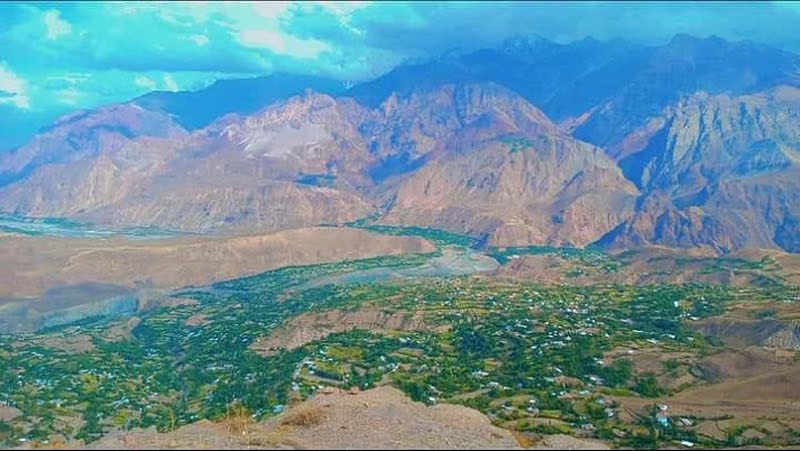
Kosht is a village in district Upper Chitral about two and half hours drive from the town of district Lower Chitral, with a total area of almost 46.48 square km. Its elevation from sea level is 2,091 meters (6,860 feet), at a latitude of 36 degree north and longitude of 72 degree east.
As per the census of 2017, the village has a total population of 9,012 with 1,277 household. This village lies across the Yarkhun river, constituting part of the area called Khov in contrast to the villages to the other side of the river, forming Biyar. A long stretch of raised tableland, locally termed Qaqlasht, also separates Khov and Biyar.
This division of the areas on either side of the river and stretches of hillocks fosters interesting myths about the people of Biyar in the minds of Khov people. It is as though across the river and beyond the mounds there is a different world of same people with similar culture and economy. This difference is cultivated in the mind or rather is a long-held perception that may not be based on facts or evidence. Many a factors contribute to it. The open and broad Biyar in comparison prompts the Khov people to accredit enlightenment and acumen to Biyar dwellers as their distinct traits. The relative facilities in most of its villages attribute to their advanced appearance in their off sea neighbours´ eyes, and their inhabitants as civilized and dynamic. Any sort of inefficiency and indolence on the part of Biyar people (Biyartek) would arouse their wonder. I had to bear teasing comments from colleagues negating my origin from Biyar during my service posting there, but ultimately some proof of my nativity within me surfaced as per their opinion. That I was hoodwinking them and that I knew all the arts was their concluding remark. We could not but be appreciative to their such perception of ours.
 The road leading up to Kosht is a slope, verging on the steep. Being scattered on the face of a mountain this road better be called a climb. The climb begins a little distance from the end of Kosht bridge connecting it to Bumbagh and Biyar. From Mulkosht, the first sub-village, the bumpy road advances up and up amidst the village till it reaches the highest point of the place which is Tiwaruk. It is of 30 to 35 minutes drive from this point to the foot of the village. But it is the most laborious when taken on foot, particularly the upward journey. And it drains all your energy out when you venture on it carrying your kid with you. If only you have a trail mate you could alleviate the exhaustion but that too when you are only carrying your own self. Nay, the exhaustion gets distracted that way.
Whether in dry season or rainfall time, this road presents an ordeal. Summer days produce the rich soil profusely enough to scatter over your boots; a vehicle pass by and you find yourself powdered through and choking. With showers and downpour the dense mud at places sticks annoyingly to shoes and where the soil was sparse greasy and viscous mud tumbles you down. In winters snow turns trickier than the soil. The soft snow hides an ice layer beneath, deceiving many travellers to an amusing and risky fall. (Sustained by inner confidence I have braved many journeys of both extreme seasons on this road) The inhabitants´perseverance in this matter is also marked. This main road branches and further branches in every direction, within the village. Indeed Kosht has no rival village in its web of roads.
Covering a vast span of area, Kosht remains a water thirsty village despite availability of water for irrigation and some springs oozing high up in the mountains and amidst the village. Pipeline is drawn for an easy access to clean drinking water to the entire village. However, Upper Kosht suffers from dearth of clean drinking water especially during winters, much to the dismay of womenfolk. Interestingly, Kosht is fertile in crops and fruits regardless of the water scarcity. Wheat, maize, barley, millet, malt, peas and beans flourish in the season. The season of mellow fruitfulness unfolds mulberries, apricots, apples, pears, peaches, grapes and walnuts in turn. Nevertheless, Kosht like many other villages in Chitral faces adverse effects of climate change. The yields of crops and fruits are affected by evolving weather events.
 An account of the many sub-villages it encompasses may interest you less, but probably you would marvel at their numbers. They are: Shinjuran, Shushragh, Barumkagh, Khalfanandeh, Sarwarabad, Shughoorkham, Gashlasht, Lasht, Gombor, Mirzandur, Domwandur, Zumbool, Lingasti, Shishder, Makhzarandeh, Jamalandeh, Godolandeh, Kishmanja, Soragh, Tiwaruk, Buxandur, Mastandur, Kolgu, Shalden, Drasun, Noghor, Sydandur, Gom, Gharigram, Domandur, Dreen, Paxalduri, Mochiandur, Golbiar, Muxodur, Hushi, Khanandur, Noroli, Shokorduri, Mulkosht, Shot, Noghormuli, Tordur, Denin, Daduandur, Verdok, Phargram, Muxdeh, Lomali, Aonadeer, Ghoru, Sandragh, Sargan, Raghdeer, Shadokanguch and Shutik. These places and the people´s hospitality are worthy discovering.
The village hosts government schools greater in number than neighbouring villages. It has one govt. high school each for boys and girls, two middle schools for boys, seven primary schools and two masjid schools. Private schools also work simultaneously: the Ideal Public School, AKES School and Jamia Rizvia.
The crave for learning and knowledge among the people here is exemplary. Being highly educated and skilled they are successfully working in various government and non-government institutions. The area has officials, in the fields of education,health,administration,science and technology, serving as commissioned officers, teachers, education officers, CSS and PMS officers, research scholars, doctors, judges, lawyers and nazims. Kosht also owns two scientists. Females have their share particularly in education and medical field. Women of the area are hardworking, and are a living testament to the resilience and tradition that define rural life. Artisan and labour force of the area are also commendable.
There is a diversity of clans but they live in mutual respect and cooperation. (Though all are revered, I apologize for not being able to mention each by name.) Some I found are Zargare, Okele, Waliye, Muhammad Baige, Rizakhel, Sangale, Ramasne, Shanawe, Doqe,Timere, Maxe, Raise, Ali Baige, Syed, Bayike, Kature, Dashmane, Qubille, Xane, Khusrawe,Quraishe, Zondre, Maqsoode, and Grasse. The two sects Sunni and Ismaili also live here in mutual harmony and peace.
Adventure and vivacity are the hallmarks of the people of Kosht. Many keep horse(s) for the game of Polo, which is a celebrated and endeared sport in this part. Among the local players late Sardar Ahmad was a distinguished player of this game. Other prominent players are Shamim Ahmad, Muhammad Azam and many others. The trio of them many a times represented Chitral at Shandoor and had many times won the final in district level competition. In a recent Jang Aman Taj Memorial Polo Tournament (season 3) held at Mastuj Shamim Ahmad, Imad ud Din and Sohail Ahmad of Kosht played for Sonoghur club and won the tournament. Football,volleyball and cricket are also the oft-practiced game here, manifesting their high spiritedness. Kosht sport festival is celebrated every year with splendour. The elevated plain ground ‘Junali’ holds competing players of polo, football and other games from both adjoining and distant villages along with swarm of jubilant spectators.The youngsters are also interested in music and cultural performance.
 The dialect of Khowar spoken in Kosht seems inclining towards the dialect of the language practiced in lower Chitral. This influence on the vernacular here may be due to the fact that mostly their matrimonial connections are held with people from lower parts of Chitral.
Landline telephone facility reportedly was also available here till the sixties, but then it got dysfunctional. There is an ancient fort in Torkosht (upper Kosht) in its decrepit form. A museum of Habib Ullah in his home also features Kosht where he has made a collection of various local and non-local ancient artifacts of artistic,cultural and historical interest. Dishwares (metal and wood) musical instruments, weapons, currencies, attires are the major items. People visit this museum, get entertained and elated. The owner has no intention of commercializing this museum, in fact has turned down few such offers. “I want only to gratify my interest and to cater for the visitors by treating them as my guests upon their visit”, he told when inquired.
In the year 2001 for the first time the whole village burnt bright with electricity, sending waves of delight all across. It was a light and life much awaited for after those hard times of darkness.
As part of oral history it is said that during the reign of Raees there was a battle between Kalash and Raees forces which ended in the victory of the latter. This bequeathed valour to the coming generation. It is also said that Lenin´s army, Bolshevik, once passing through Kosht took the mud from the marsh near Gombor to make an idol out of it. Because of this, gombor was initially named Budh(idol). Some thirty years ago this name was changed to the current one.
Sharing close association with Kosht is a place of picturesque beauty, Morder. The later is a continuation of the former but only for a deep chasm “Mordergole” between them which separates the two villages. Mostly the two are taken as twin villages. Morder is also popular for its good natured, educated and sociable people.
As one leaves the beautiful village of Kosht, its liveliness,warmth ,and gentle pace linger. Despite facing numerous challenges the residents of the village demonstrate remarkable resistance and adaptability.Their unwavering commitment to their area and way of life serves as a powerful inspiration. Their steady spirit and contentment offer valuable lessons for the increasingly urbanized world.Thus,beyond its rustic facade Kosht conceals instances of struggle and triumph.
As we reflect on the village’s story ,we are reminded that the true strength of any community lies in its people—their courage,compassion and unshakable spirit. As for my experience here I am grateful for the lessons learnt and the memories forged in this corner of the region.